Showing posts with label man. Show all posts

Tuesday, August 11, 2015

Who Orbits Whom?

This is an excerpt from Female Piety, which a friend texted me.

"This then is woman's true position, and if anything more need be said to prove it from the records of Christianity, we may refer to apostolic language in other places, where wives are enjoined to be subject to their husbands in all things, even as the church is subject to Christ. Nor is the apostle Paul alone in this, for Peter writes in the same strain. Let woman then bow to this authority, nor feel herself degraded by such submission. It has been said, that in domestic life, man shines as the sun, but woman as the moon, with a splendor borrowed from the man. May it not be said with greater truth and propriety, and less invidiously, that man shines as the primary planet, reflecting the glory of God, who is the centre of the moral universe; and woman while she equally derives her splendor from the central luminary and is governed by his attraction, yet is the satellite of man, revolves around him, follows him in his course, and ministers to him."

~ Rak Chazak

Saturday, August 8, 2015

Poem: Community

When in the beginning, all of the stuff of the cosmos had been organized
And not one creation deviated from the Creator's perfect design
All was not well, for man by himself, was lacking in something besides

He lacked not in purity, intellect, strength, creativity, life or desire
If labor was favored, Adam was capable. No goal could not be acquired
But there was a whole other realm of experience to which he could not aspire

Man by himself does poor company keep, and his actions are wholly self-serving
But give him relations, and for a plot twist, make them all, of his love, undeserving
And fix within each the capacity for selfless love and its requisite yearning

NOW! Man in community is more of a model of a relational Father above
When, denying himself, he freely surrenders -- expressing the Trinity's love --
And loves his own wife with no thought of reward: this is how marriage is done

"It is not good for man to be alone" -- and this is what that Scripture means:
That, though we are physical beings, we know, all is not what it seems:
When a man connects spiritually with his friend, his joy will surpass his best dreams.

~ Rak Chazak

Wednesday, March 11, 2015

People Who Accuse Others of Victim-Blaming Are Demeaning Women

Victim Blaming: Accusing someone on the receiving end of some calamity to be responsible for its occurrence. 

ex: "Telling women not to put themselves in situations where they might be sexually assaulted is blaming the victim. The only thing that causes rape is rapists."

Often heard from: feminists, "social justice warriors," change advocates of various kinds that are commenting on violence or gender related issues.

Please see my treatise on why this argument is only half true, and ultimately hurtful despite its being (maybe) well-intentioned: Treatise: Third-Wave Feminism's Irresponsibility Double-Standard

*  *        *  *        *  *
So how does accusing someone of "victim-blaming" demean women?, I'm sure you're dying to know.

I'll answer. But first let me clarify that it's certainly possible to be legitimately at fault for blaming victims, which is wrong.

Scenario A: "She should have known better. By getting wasted drunk around a bunch of frat guys, she brought this on herself."
Verdict: Victim Blaming. Disgusting assertion that she's responsible for someone else's sins against her.

Scenario B: "Rapists bear the full responsibility for their own actions. Even so, it's wise to be aware of risks and take action to mitigate your exposure to them. Please consider the way you dress, the people you socialize with, whether you walk alone, whether you carry mace/air horns/a gun, and whether you overtly sexually entice men around you, as ways to help protect yourself."
Verdict: Not Victim-Blaming. You can take action to protect yourself without implying that you're responsible for what others do to you otherwise.

And yet, this is often attacked as "blaming the victim" by feminists in online fora. I submit that this could be because the feminists a) really have no clue how to solve the problem and don't want to believe that they can fix it because that makes them feel uncomfortable and morally conflicted, and b) really resent men and want all the attention and responsibility to be theirs (men's).
  1. Teaching someone how to drive is not blaming the victim if they are involved in a car crash.
  2. Police officers wearing bulletproof vests are not blaming the victims of homicides for their gunshot wounds.
  3. Teaching wilderness survival, gardening, hunting etc doesn't "blame the victims" of famine, starvation, or those who die of thirst or exposure to the elements.
Giving someone tips for how to protect themselves from getting hurt is not asserting that they are responsible for undesirable outcomes, when something happens that hurts them, which are out of their control.

Now that that has been emphasized, there are some direct consequences of this.

When someone discusses rape prevention in the vein of scenario B above, and someone responds to accuse them of "blaming the victim," then that person is actually demeaning women and promoting sexist attitudes that contribute to rape.

Say whaaat? Let me guide your thinking:

Paradigm shift 1
Taking away someone's responsibility takes away their ability. Taking away their ability takes away their power to effect change. Taking away their power takes away their freedom of choice, and makes them helpless victims of circumstance, at the mercy of their abusers.

This is what denying women their right to prevent rape (by denying that they have the ability or responsibility to protect themselves) accomplishes.

Paradigm shift 2
By asserting that rapists are the sole factor in rape**, advocates are denying the woman's responsibility over herself. By denying her responsibility, they assert that women are incapable of doing anything to protect themselves that might actually decrease the chances of getting raped. This makes women out to be defenseless. This view is sexist because it portrays women as weak and ineffective compared to men, who always get what they want because they alone have the power and are the sole determinant of what they will be able to do.

Paradigm shift synthesis
Taken together, the logical conclusions of accusing "scenario B men" of "blaming the victim" is the promotion of the belief that women are incapable, and men are capable. That women are irresponsible, and men are responsible*. That men can rape, but women cannot stop rape. That women don't have the freedom of choice, to choose their own destinies, in the context of whether they will be raped or not. That women are victims, and that men, by contrast, must be victors. That women are helpless and defenseless and at the mercy of the decisions that men make. That men get what they want, when they want it, from whom they want it. The buildup of all these contrasts encourages the subconscious prejudice in both men and women to see women as weak and inferior and men as strong and superior. It is the very epitome of sexism.

Therefore, though promulgated in the name of feminism and the defense of women, any attacks against the character or motive of a man, or the impact of his statements, if he encourages women to seek to protect themselves from the sort of men who would take advantage of them, nevertheless has the effect of PROMOTING SEXISM.

Feminism = sexism. Against women, no less. I could not be clearer.

Women, think twice about attacking any man that disagrees with you about some issue that touches on gender relations.

Men, take courage, and be careful to make sure you speak wisely on this issue. Sexism rules on "both sides," and it is your responsibility, as someone who seeks to honor woman, to fight against the things that hurt her even when it's what she believes with all her heart to be in her best interest.

~ Rak Chazak

* note the equivocation in these terms. It's nevertheless the impact of using these words without clarification and therefore the conclusion is sound.

** Rapists are solely responsible for their choice TO rape. But rapists don't exist in a void and strike at random. This is evidenced by the fact that most rape is "acquaintance rape." Rapists must CHOOSE their targets, and to do that they need motive and opportunity. You have the ability to deny them the opportunity, and to some extent their motives. If you have this ability, should you act on it? Then that is the same as saying that you're responsible for your own actions that can mitigate or exacerbate the risk of being raped. Please read this treatise to see that there are two senses of the word 'responsibility': culpability and personal governance. To say that you're accountable for yourself is not to say that you are to blame for what someone else does to you. The consequences of denying personal responsibility over your choices leads to absurdity.

Monday, February 2, 2015

AWPATT XV: January 17-February 2 (Thoughts 231-247)

231 It’s got to be a good sign when I can go this long without deferring to saying, “I hope she’ll be friendly.” I’ve perused enough dating profiles from time to time (mainly out of curiosity, wanting to see what’s out there) that I’ve had ample opportunity to be dismayed by the shallowness, not of desire (it’s hardly a lousy character trait to want to be around friendly people) but of the amount of thought put into what people are looking for. My anecdotal survey of sites like these turned out that the vast majority of ‘what I’m looking for’ sections, at least for women, say something like “a guy who can make me laugh,” “a guy with a beard/tattoos,” “a guy my friends will like,” “a guy who doesn’t say ‘your’ when he should say ‘you’re’,” “a guy who’s taller than me,” “a guy who can go out or stay home,” “a guy who can keep up with me.”

If you thought I was superficial when I talked about height in Thoughts #50-52, you should see some of these profiles. I was just analyzing subconscious inclinations in myself, but made no hard statement categorically excluding different heights from “wife potential.” But for many girls on dating sites, it’s serious, or at least one of the only things they put thought into. But what I notice when I see those statements is that there’s next to nothing you can learn about a person’s character based on their meeting those criteria. Some profiles will pretend that there’s more to be worked through once she’s interested already, but that just sets you up for a high rate of frustration, because your filter isn’t tuned well enough.

Yes, I want someone friendly, but in person, that’s the first thing I notice, and ultimately it’s a given, so it almost doesn’t even enter into the consideration of what sort of a woman I’m looking for. I have deeper compatibility concerns in mind than the utmost superficial things imaginable. And I’m looking for someone with a similar depth of forethought in their relationship plans. Statements like the ones I quoted show carelessness and possibly intellectual stupidity, and that’s a turnoff, so I avoid people like that, but without being disrespectful.

232 I don’t believe I mentioned being interested in a studious woman. I’ve talked about intelligence, knowledge, that she’s careful to think about things before making decisions, but not specifically about the pursuit of knowledge in itself. While someone who goes to school for the sake of schooling, and to insulate themselves from reality, is not highly appealing, someone who’s had a certain measure of achievement in terms of education will stand out. Now, pretentious Type-A’s are exhausting to be on the receiving end of, so not every personality type is made more magnetic by the increase of education. For some, it reveals abhorrent ego issues. But perhaps more important is the question of whether you can learn outside of structured academia. Someone who pursues learning on their own time is like someone who exercises regularly. They’re not content to languish with what they already have, but are honing it, to get better and better, for themselves and others. That is the root attitude that will benefit any relationship. Because someone who thinks they can improve is someone who isn’t likely to think that they’ve “already arrived,” and thus is less apt to be arrogant. It’s not a guarantee, as I mentioned, but a woman who is reading and learning on her own time is more interesting to me because of what it implies about her character.

233 Noses! Do you like ‘em big or small? It’s one of those things that I don’t typically notice, like prescription eyeglasses, but when I do, it’s temporarily amazing, as I look around and compare others’ to appreciate the variety. I don’t think I like flattened or broad noses very much, but I’ve been intrigued by noticing that a diversity in relative size can still be attractive to me. I remember reading somewhere, where Song of Solomon was being referenced, that large noses were considered appealing in Hebrew culture (Song makes a big deal out of the Shulamite woman’s nose in one section). It’s funny, considering that from ancient Egyptian images of Hebrews to modern day stereotypes, Jews are characterized as having big noses. This is in the back of my mind every time I notice an attractive woman who has a noticeably larger than average nose. I suppose I don’t mind them if they have an isosceles shape, have no bumps on the ridge, and aren’t over-bulbous or over-pointy. Longer better than shorter. Thinner rather than thicker. It’s not usually that I think about what shape of someone’s nose might be more attractive, but I suppose it’s one of the subconscious impulses in your mind, like head shape, eye spacing, etc, that work together to give you the instant reflex of “that’s good looking,” or “that’s kinda odd,” even if you can’t quite put your finger on what makes that person different from others. Maybe it’s the nose.

234 That thought came from noticing a very friendly woman’s nose in one of my prerequisite courses I’m taking. I’m diverting to talk about light subjects before beginning an excursus on “how to approach dating when dating isn’t the focus/goal/objective.” In each of my classes, there are 5 or less males, making the ratio something like 1:6 or 1:5 men to women in each respective course. This is a little odd. I realize the field might be less interesting to men, but the vast difference could have more to do with a simple, unemphasized detail that I’ve been noticing in trend reports for higher education. There’s less and less men, percentage-wise, in higher ed courses, the higher you go. Amazingly, the focus of grants and government projects is still on getting more women to go to school, but the tables have already turned. It’s something like a 40-60% split in the makeup of men and women who attain baccalaureate degrees in this country (unless perhaps it was Master’s). What are the possible consequences of this? Statistics show that more boys are born than girls, so it’s not explained by population. There is a huge chunk of males missing from classrooms. What are the possible reasons, or consequences? Who knows? No one’s funneling resources to investigate; it’s as if men don’t matter. Oh, I’m not bitter. It’s just as easy to take the alternate view, that “women need the help, men don’t.” But I refuse to take either one. It’s just a fact that no one is obligated to help me, so whether they do or don’t, the responsibility is still on the individual to pursue educational success. But I can’t help but wonder if, given the dramatically high gender disproportion in these classes, it might be within a course or within the field itself that I meet my future wife, just looking at it from a statistical possibility perspective. There’s scarcely anywhere else I could interact personally with so many women close to my age, except for bars/clubs/concerts or church-related youth events. For a middle ground in terms of the chance of meeting a wholesome virtuous lady, the classroom is not a terrible place to be.

235 Addendum to Thoughts #22 & 199. What are the chances that I’ll end up with a younger woman? As recently as a year or two ago, I would defiantly have refused the notion that I wouldn’t marry someone within a half year of my age. But that’s idealism, and the realistic outcome might be different. Should I refuse someone who’s perfect in every other way but happens to be 5 years my junior (if I’m 28 and she’s 23, for example)? The older I get, the more likely this becomes, because the margin of what’s appropriate expands with age. Up to now, if I had entered a relationship with someone 2 years younger, they’d have been 21 or less. But now, 2 years younger is 23, which is not quite so young as to have a high likelihood of being immature or naïve. Since I probably won’t seriously look for a spouse until age 27-28, anticipating a solid career by that time, the idea that I’d get to know someone now who’s 22, and maintain a friendship until then, when she’d be 25, is not very far-fetched.

I think the reason I’m resistant and cautious to contemplating a relationship with someone 5-7 years younger, other than the difference in life experience, is that for most of my life up to now, such an age difference would have been monumental and clearly inappropriate: 18 and 13 year olds? 22 and 15 year olds? Eeugh. But people who are 33 and 25 routinely marry, and the brute age difference is even wider there. But they are in the same age group. Adults. Because people mature irrespective of their biological age, it could be that a marriage to a 23 year old, at age 28, would be wiser than to a 27 year old who is far more foolish. Just letting the thought hit me as actually concerning me, and not just as a distant hypothetical, is a source of amazement to consider.

The really weird thing about it is pondering where such a person would be now. If I married a 23 year old at age 29, then by the time I met her and became engaged, we’d have been 22 and 28, meaning that there’s a possibility that a woman like that would just now be graduating high school, or a freshman or sophomore in college. In other words, I’d have no hope of meeting her now, anyway. Our life trajectories don't intersect at this time. So it may be several years before I’m engaged, not only because I’m waiting to get a career and stable income, and not only because I want to be careful to find the right person, but even because, if the ‘playing field’ is too devoid of suitable candidates my age, my future wife COULD BE, because of our age difference, not even here yet. Not arrived on scene. Somewhere else entirely.

What a mind-boggling thought.

236 Taking those last two thoughts together, there’s a real possibility that I might either meet someone in church or at university, while taking courses to get where I want to get. And they might be significantly younger. Respect for them would demand that I don’t make their life more difficult by ‘jumping the gun,’ and inadvertently pressuring them to commit long before the opportunity for engagement arises. But if they turned out to be fond of me, and for those years did not enter a relationship with another young man, then that would be gratifying. I can see myself like Boaz (paraphrasing), “you’ve shown me more kindness than before, because you could have had any younger man you wanted, but did not.” (Ruth 3:10) It’s equally likely that I can’t find anyone there, either, however, and may nevertheless resort to a dating site later on, but only God knows. I have the opportunity to wonder now, that I may marvel later.

How to Approach Dating when Dating isn’t the Focus, Goal, or Objective

Friday, January 16, 2015

AWPATT XIV: December 22-January 16 (Thoughts 205-230)

The A-Z Compilation (#1) : 7,000 word excursus on what sort of qualities I would desire for my wife to have. 

If you're young, you may read something you've never heard of before, so I encourage you to take a look.


Here is the start of the list, and the rest of the AWPATT will be found after the jump break.


205 I want a woman who is assertive. Without forcing her way, she needs to be able to express her mind and take a confident stand on everything she believes. A woman whose opinions I can never find out, or which are prone to change at any moment, is not a woman I can trust.

206 I want a woman who is bold. Who will not withdraw in fear or shame or uncertainty but will passionately hold fast to what she knows is right. She ought to be impervious to mere disagreement, however strong. This foreshadows her faithfulness as a spouse.

207 I want a woman who is compassionate. She ought to care about others – this is not only very feminine, but an important human trait, and as a Christian she should have a well-developed sense of empathy. It should be tempered with truth and not given to the wrong people, or emotionally, but decisively.

208 I want a woman who is discerning. A woman who can’t tell “right from almost right” is like a door that is always open. A woman with poor judgment or capacity to spot lies is dreadfully unreliable, and I will flee from her.

209 I want a woman who is elegant. That mystery quality that is difficult to define. Most people would probably use the term “graceful,” but I prefer to limit my use of that word to the strictly Biblical meaning. There’s a certain combination of clothing, physical beauty, confidence and character that goes into my attributing it to someone. Someone for whom it seems effortless to be convivial, restrained, cheerful, relaxed, mutually engaged, thoughtful and kind, rather than for whom it is an exhausting role-play.

210 I want a woman who is faithful. This contains the concept of loyalty in commitment, as well as the importance of believing what is true and right, and not just believing something strongly. “Can two walk together unless they are in agreement?” Amos 3:3. Believing the same will enable us to do that. And this is the second main purpose of this blog – to allow her to evaluate that.

211 I want a woman who is graceful. Grace, Biblically, is “giving something good a) that is not deserved, or b) unconditionally.” The two go hand in hand. Suppose you have trouble comprehending the first meaning, because you believe your beloved deserves good things from you. If they deserve it, consider nevertheless that you do not love them because they deserve it, but as a matter of fact unto itself. And consider further that they deserve love because God says that’s how they ought to be treated, not because they have an innate character quality or deed to their name that empowers them to require such treatment from others. For if there is good in them, where does it come from but God, after all? So you treat them well based not on them but on God, who never changes. This means that you act in love toward them whether or not you think they deserve it, because it’s not based on their performance but the character of God. This love is unconditional.

This is grace. I will treat you this way. And it’s an absolute requirement for me that my fiancée understands and lives this truth out.

Applying grace to your view of how you should be treated leads to the understanding that you have two options:
1) believe you deserve to be treated in _____ way
2) believe you don’t deserve anything in and of yourself

There are consequences based on two outcomes:
1) you “get what you deserve”
2) you don’t

In the 1st case, if you ‘get what you deserve,’ you might be grateful, but you were expecting it anyway. If you don’t get it, on the other hand, you become bitter, and resentful at being mistreated. In the 2nd case, you have shelved your expectations, because you don’t believe you deserve (are entitled to) anything. Then, everything good you receive makes you incredibly joyful and thankful, as if taken by pleasant surprise, because it’s a special and wonderful thing each and every time something good happens.

Which would you rather have?

Choose grace.

Wednesday, August 14, 2013

"No Man Is As Polite As You"

Ehm. Not to toot my own horn. I wasn't expecting such a compliment, but that's what made it stand out when I heard it. I'm going to attempt to draw something valuable out of it.

I just began working at a fast-food chain restaurant, and each of the days I was there, there were also two or three Ukranian girls at the fry-station, sandwich area and drive-thru station. I worked the cash register. In the middle of the day, there would tend to be a 'rush,' where there's more than two or three people in line at a time, for an extended period of maybe an hour or more (at our establishment, at least)--this prevented us from being able to talk much initially, not that you should be doing too much of that when you're on the clock, anyway. But over the 5 days we were there at the same time, we had the opportunity to trade some words back and forth. I "impressed" them with showing that I knew the words 'spaziba' and 'dobre utre' (I'm spelling them as they sound to me, not according to any actual standard), which mean 'thank you' and 'good morning.' I learned 'dobre veche' (good evening), 'bon scheuye spaziba' (thank you very much) and was reminded of the word I'd forgotten, 'izviñi,' which means both 'excuse me' and 'I'm sorry.' It' a very utilitarian word, thus. 'Parschallista' means both 'please' and 'you're welcome,' making it very easy to get the words right if you're just learning the language! Specifically, this language is Russian. There is a Ukranian language, but Russian is widely spoken in the country and it's the only thing I heard them speak while they were there.

They were there doing a student work-exchange over the summer. I've run into Russian college students doing that before, when I worked at a summer camp. There was a girl named Vicka who was really motivated to try to experience everything (rock wall, swimming pool, biking) while she was there, and I had the most opportunity to talk to her. Some of the other guy staffers suspected us of being interested in each other, romantically. That wasn't the case. In February, there had been some Thai girls doing a similar exchange at the same restaurant. So it seems that this is a widespread thing, where other countries send students here to work and live for a short amount of time, to have the opportunity to practice their English, interact with actual Americans, and of course see the sights. Always surprised that my small town ever gets the interest of people from far away, I nevertheless enjoy being a part of the impression that these people get of the place when they leave.
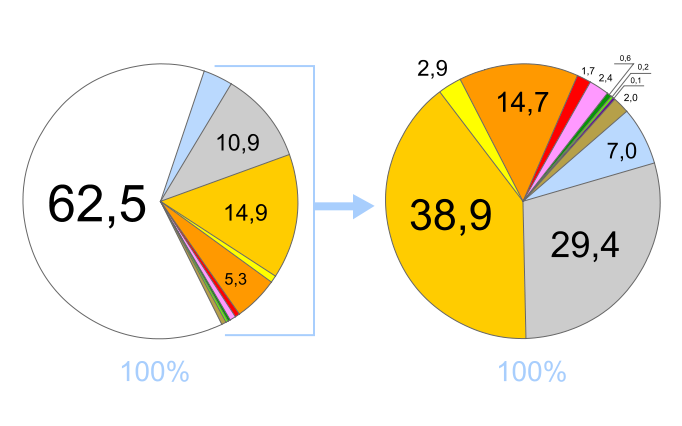
Free Use, Wiki Commons
The above graph on the left shows the religious diversity in the Ukraine. White is atheist, and the rest of the colors are mainly sects of the Orthodox Catholic Church. This is typical of European countries of the present time--there tends to be more nontheists than any other individual group in these countries, though there are long histories of the influence of traditional religions, mostly Christian or nominally christian, in those places. I bring this up because while I'm not assuming what the girls I worked with believe, it's nevertheless a reasonable inference to make, that what I was asked was influenced in part by the national spiritual landscape of their home country, irrespective of their personal beliefs.

The "more American" of the girls (spoke better English, not that the others were unable to communicate or anything) spoke up when they were all standing together and we were talking. She said, midst giggles from the other two, that 'no man can be (or is, I forget which she said) as polite as you.' This was after first asking why I was so polite. To me, I was just behaving normally, not putting on an act in order to speak with customers, although maybe putting in more effort to appear cheerful and friendly than usual, but other than that, 'what you see is what you get.' I tried to think of a reason, and gave her that it's just natural to me to be respectful like that, that it's genuine. "No men are as polite as you," she said. And now I come to the twofold impression I gained from the experience:


1. It struck me that this has happened before. It isn't something that contains itself based on geography. I've met many an American girl that treated me with suspicion for no readily explainable reason. Through the grapevine, it's come forth that people sometimes have the impression that I'm putting on a front, not being genuine, that maybe I'm hiding something. They think I'm too nice. Of all the things to have for a problem, right? People think I'm faking my personality because they can't see why I should seem so happy or pleasant to others, particularly strangers. It hurts a little, but I'm more happy that it's because of being too friendly and nice than because I come across as the opposite. I wouldn't be surprised if a great number of potential friendships or romantic relationships were prevented in the past because my demeanor motivated people to be suspicious of me. It's a loss, to be sure, but on the other hand it's inadvertently screened for people who are more confident in themselves and less judgmental of others to be the sort of people that I eventually get closer to. And lest I be remiss, this all is directly tied to my faith--or rather, my regeneration. You can really tell the difference between a saved and unsaved person by whether they have joy or whether they do not. In general, of course. I simply want to affirm that I have the outward personality that I have because I have the inside satisfaction and joy that comes from knowing the answers to the tough questions of life, and having relief in the knowledge that I know where I'm going, I know what my purpose is, and I have a healthy relationship with my heavenly Father. It isn't any more complicated than that. Which brings me to my next point.


2. Shortly after that, the young girl (they were all about 19--at 23, I feel fairly old) asked me if I was religious. For simplicity's sake, I didn't argue about the meaning of the word, and decided to answer 'yes.' I wanted to make myself understood and not confuse her. She responded, "ah, that explains it." A little while after, she asked me if I went to church and I explained that I hadn't had the opportunity to visit during college and currently didn't have a car (see earlier blog post). She said, 'aha, well you're not *really* religious, then,' and this may have been her teasing me and possibly attempting to bring some jocularity into the conversation to draw it away from the serious topic, which people can find uncomfortable, because the other girls laughed at her and implied she was messing with me. I did respond that 'well, if being religious just means you go, sit, and leave, once a week, then yeah, I'm not really religious.' So there you see that I did make a slight attempt to define the term and not imply that I was just your run-of-the-mill lame churchian, or whatever she might have had in the back of her mind because of her prior experience, when she asked.

It was a short but fascinating exchange, to me. My surprise at the declaration by the girl (and the two others emphatically agreed on that point) that I was inhumanly polite can be explained by the fact that there's very few Christians (capital C) around, and consequently most people live the bulk of their lives without really getting to see the fruit of sanctification in another person. So what's the reason why I was so polite and why they were so confounded by my behavior so as to comment on it -- and to declare that no other man on earth was as polite as me, no less? It comes down to Christ and His grace. His gospel. It always comes back to that. He is at the root of it all. 

So that was a little way in which I might have 'witnessed,' recently. Not something extremely remarkable, since I didn't exactly have (take?) the opportunity to share the full Gospel with them, but I'm hoping God will take that memory and use it to bring fruit in their lives when the moment is right in the future.

~ Rak Chazak

Sunday, May 19, 2013

How Could Sexual Urges Be God-Given?

Culture tells us that there's two main ways to approach sex: as something shameful, or as just something people do. Yeah, there are some who have the idea that sex is something beautiful or romantic or special, but these are unilaterally presented as a minority and as being sheltered, naive and simply wrong. My suspicion is that those who have had sex very young because they saw it as something they 'had' to do, probably take the view that sex isn't special subsequent to having a less-than-wonderful first experience. Upon wondering "was that it?" they don't want to face up to that they did something wrong, so instead they blame the whole concept of sex itself. 

There's a better way.

I am one of those that Hollywood(movies) and New York(sitcoms) pretend don't exist: the romantic. The person who surely must be hopelessly naive if he thinks that sex can be something beautiful and exciting, not just prior to the first time, but every time from then on. But if I simply believed this about sex in general, I would be naive. Instead, my actual view, as with most of my personal beliefs, is very conditional. Depending on the situation, something can be very good or very bad.

Sex is a tool. Like any tool, it has the capacity to be used to create amazing things. But if used wrongly, it can cause horrific injury and even death. (I'm thinking of a circle saw as the metaphor, in case anyone's wondering :D ). If I approach a deadly tool thinking of it as an innocent toy that can only bring me pleasure, then it is inevitable that I will hurt myself, possibly severely, because I had no respect for the tool; I had not submitted my mind to the knowledge of how to use it properly. Sex, if used properly as it should, within a loving, committed-for-life, relationship between only one man and only one woman, then it can bring great blessings to the both of them -- even the greatest blessing of all, life. Sex, if used improperly, becomes an instrument of abuse and defilement, destroying the honor of both men and women and devastating the lives of single mothers and the offspring of men who were too cowardly to stand up and raise their families, as is the man's duty.

If there's a place for sex, then there's a place for sexual desires. And while the line between good desire and lust is nearly impossible for man to toe, and therefore should not be attempted, the fact that we have sexual urges is a divine message to us, telling us something very important about who we are and what our purpose is. 

Watch these two short videos. They'll explain the purpose of sexual desire from a Biblical perspective.


If you want more, here's a bit of further background from Josh Harris.

Taken together, these clips give great advice. The message is this: your sexual desires are not supposed to be an obstacle to you living a godly life. Instead, they are given to you as a motivation to get your life in order so that you can marry and fulfill those desires within the appropriate context. Imagine your desires as rain. It does no good if the rain falls in the ocean, but if it falls on fertile ground it can enable plants to grow -- it can create life. If you have sexual desires, you know you're not called to a life of singleness. Consequently, then, when you pour your energies into the appropriate pursuit, you will reap amazing rewards and be so much more fulfilled than you could possibly be if you had chosen a promiscuous lifestyle.

Just like Ecclesiastes says, "there is a time for every purpose under heaven." There is a time and a place to "glut" on your sexual lusts, as RW Glenn says in his clip above, and that time will come when you have laid the groundwork and entered into a lifelong covenantal marriage relationship. Don't sell your future spouse short by wasting your sexuality on other people, real or imaginary. Pour yourself into them. Enrich their life and yours will be enriched also.

~ Rak Chazak